
Underwater desegregate concrete
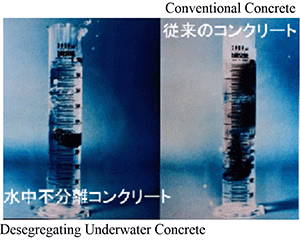
Development of an underwater concrete to build enormous substructures in a short time
For the Honshu-Shikoku Bridges, it was indispensable to develop underwater concrete with excellent quality and workability.
Based on numerous construction tests and research over many viewpoints in several years, it became possible to use prepacked concrete in the Seto-Ohashi Bridge. Considering the results of this experience, underwater desegregate concrete was developed to further improve the economic and rapid construction for the construction of the Akashi-Kaikyo Bridge.
Highly workable concrete
Highly workable concrete, in which high-quality, high-volume concrete placing is possible
The mass concrete with dense structural steel reinforcements and reinforcing bars are placed using a large pump and manual vibrators. And it was difficult to improve the workability while securing quality.
When constructing the Akashi-Kaikyo Bridge, we used highly workable concrete, which was developed based on new concepts after conducting numerous experiments. The development of this highly workable concrete made it possible to rapidly construct high-quality mass concrete in several anchorages, including those of the Akashi-Kaikyo Bridge.
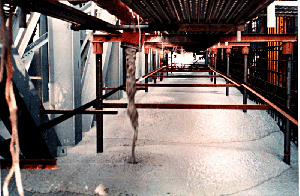
Low-heat cement
Low-heat cement to prevent thermal cracking in structures
In massive concrete structures, large amounts of heat of hydration generated during concrete curing caused cracking. To prevent this, conventional measures focused on construction methods to minimize temperature rise.
To address these thermal cracks, we developed a low-heat cement that chemically reduces temperature rise. This made it possible to rapidly construct large-volume concrete, reduced cooling costs, and ensured quality.